See all of our heating and cooling services.
Short answer
A heat pump behaving oddly in winter is often behaving correctly: defrost cycles briefly reverse the unit to clear the outdoor coil, sometimes with steam and a pause in heating. A genuine fault looks different: the outdoor unit encased in ice rather than frosted, water indoors, or repeated shutdowns. Knowing which you are looking at prevents a service call that finds nothing wrong, and prevents ignoring one that matters.
Ice building on and around the unit, not clearing at the end of a cycle is the clearest signal that defrost is not working. Note what you saw, how often, and whether heating recovered on its own: a quote written against that description is far more likely to address the actual fault than one written against 'not heating properly'.
Jobs this covers
- Ductless mini-split repair
- Ducted heat pump repair
- No-heat and no-cooling diagnosis
- Error-code service
- Condensate and water-leak repair
- Defrost and icing problems
Common heat pump faults and warning signs
- An error code appears
- The unit blows the wrong temperature
- Ice builds up and does not clear
- Water leaks from an indoor head
- The outdoor unit is unusually loud
- One zone works and another does not
What service may include
Error codes point to the failed part. A qualified technician may check filters and airflow, sensors, controls, electrical components, drainage, outdoor-unit condition, defrost operation and the sealed refrigerant circuit.
What affects the recommendation and price
Warranty status can decide who pays. Brand, model, warranty, fault code, number of zones, access, parts, refrigerant type and whether the problem is electrical, drainage or sealed-system related affect repair cost.
What is different around Burlington
Many local heat pumps went in through utility rebate programs in the last few years, so a good share are still under manufacturer warranty, which decides who repairs them and what is covered. Keep the installation date and the warranty registration with the paperwork.
What a written quote should tell you
- The error code or fault reported, and what the diagnosis determined
- Whether refrigerant was added, and if so where the leak is. Topping up without finding it is not a repair
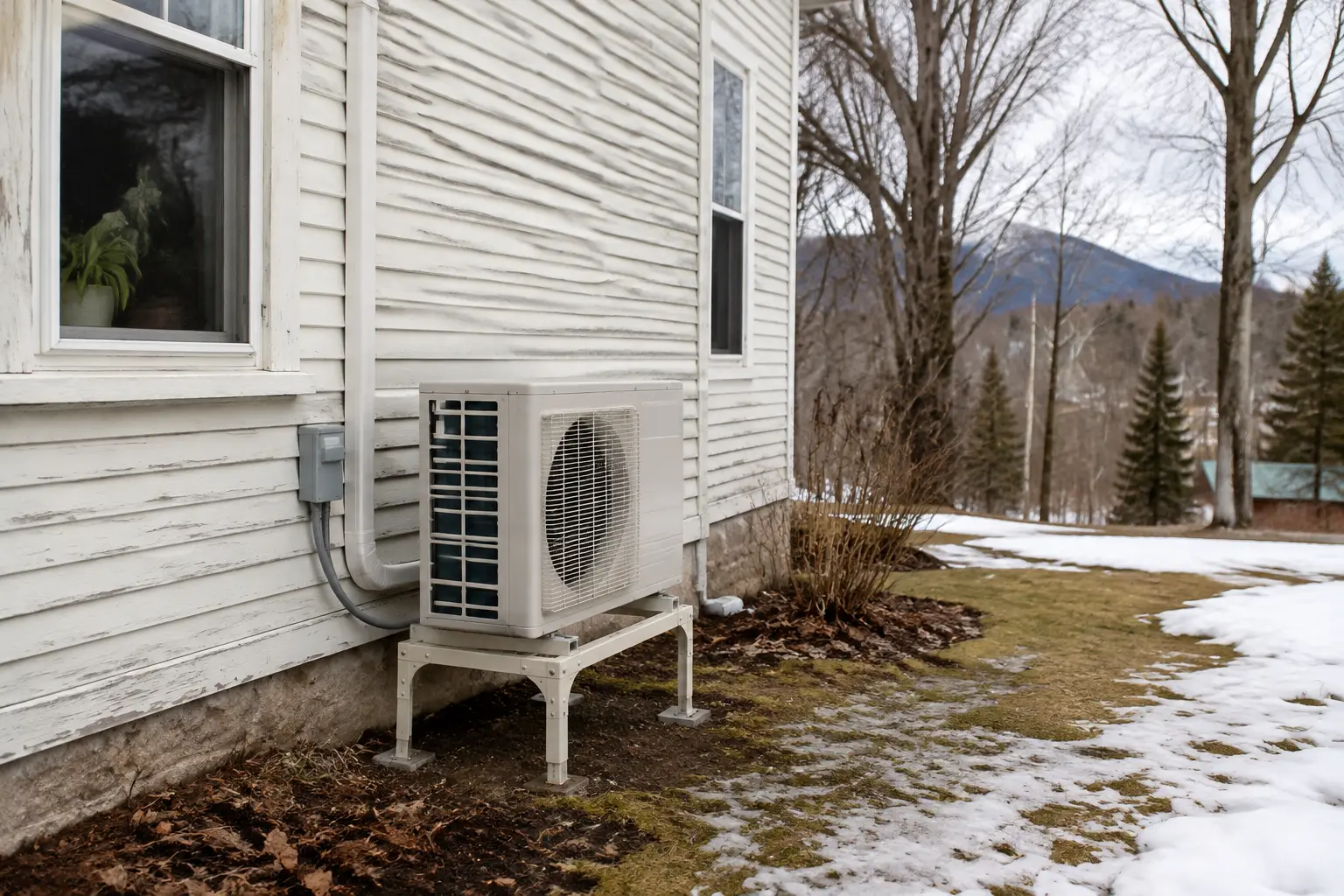
- Whether the outdoor unit's siting is contributing, through snow, drifting or roof runoff
- Whether the behaviour is a fault at all, or normal defrost operation
- Warranty status, since heat-pump compressors often carry long manufacturer coverage
| What you see | Normal or fault |
|---|---|
| Steam and a pause in heating while the unit runs in reverse | Normal defrost: it briefly reverses to clear the outdoor coil |
| The outdoor unit is encased in ice, not frosted | A fault: ice building on and around the unit and not clearing at the end of a cycle is the clearest sign defrost is not working |
| Water running from an indoor head | A fault |
| Repeated shutdowns, or it no longer reaches temperature in conditions it used to manage | A fault; note what you saw and how often before you call |
Safety comes first
Turn equipment off and use professional help for burning odor, sparking, damaged wiring or a heavy water leak near electrical components.
Common questions
Is frost on the outdoor unit normal?
Some frost can be normal in heating mode and should clear during defrost. Heavy persistent ice or repeated shutdowns need service.
Why is water dripping from the indoor unit?
A blocked or damaged condensate path, dirty coil, frozen coil or installation problem may be responsible.
Can any HVAC company repair a mini-split?
Not every company services every brand or refrigerant system. Include the brand, model and error code.
Should I reset the breaker?
Avoid repeated resets. A tripping breaker can indicate an electrical fault that needs professional evaluation.
What is a defrost cycle and why does my outdoor unit steam?
In heating mode the outdoor coil is colder than the outside air, so moisture condenses and freezes on it. Periodically the unit reverses itself briefly, running in cooling mode to warm that coil, and melts the accumulated frost, which is the defrost cycle. During it the unit may make unfamiliar sounds, the fan may stop, and steam commonly rises from the outdoor unit as the melt hits cold air. All of that is normal and is often reported as a fault. What is not normal is a unit that stays encased in ice, defrosts constantly, or sits in a pool of refrozen meltwater because it has no drainage beneath it.
How do I know if my heat pump is low on refrigerant?
The symptom pattern is reduced capacity instead of a hard failure: it runs almost constantly, output air is not as warm as it was, bills climb, and in cooling mode there may be ice on the refrigerant lines or the indoor coil. Confirming it requires gauges. The important follow-up question is where the refrigerant went. A sealed system does not consume refrigerant, so low charge means a leak, and simply topping it up without finding the leak means paying for refrigerant twice and venting it in between, which is also a federal compliance issue for the contractor.
What can I check on a heat pump before calling?
Four things. Clean or replace the filters: on a ductless head these are washable panels behind the front cover and they clog with dust surprisingly fast. Clear the outdoor unit of snow, ice, leaves and anything stacked against it, allowing generous clearance on all sides and beneath. Check the breaker and the outdoor disconnect. And confirm the remote or thermostat is actually in the mode you think, because a head left in cooling mode or on a schedule is a common false alarm. Do not chip ice off a coil with anything hard. The fins and the tubing damage easily.
What happens if a heat pump is running but not heating well?
It is usually either low on refrigerant or iced up, and both get worse. A leaking system runs longer for less output, the compressor works in conditions it was not designed for, and continued running on a low charge can destroy the compressor, which is often the point at which repair stops making financial sense. Persistent icing that the defrost cycle is not clearing points to airflow, a defrost fault or a drainage problem, and running through it stresses the same components. Neither one is a wait-and-see situation.
How long do heat pumps last in Vermont?
Roughly twelve to eighteen years for a well-maintained cold-climate unit, with the outdoor unit's exposure being a meaningful variable here: salt spray near a plowed road, constant snow burial, or ice shedding from a roof all shorten it. Annual maintenance is more consequential for a heat pump than for a furnace, because a heat pump runs year-round in both modes rather than seasonally, accumulating roughly twice the operating hours.
Is my heat pump still under warranty?
Quite possibly, and it is worth checking before authorising a paid repair. Manufacturer warranties on heat pump compressors and parts commonly run five to twelve years, but many are conditional on the unit having been registered within a window after installation and on documented annual maintenance: both of which owners routinely miss. Labour is usually covered for a much shorter period than parts. Find the model and serial numbers on the outdoor unit's data plate and check with the manufacturer directly. The answer sometimes changes the repair-or-replace decision entirely.
Is my heat pump still under warranty for this repair?
Quite possibly, and it is worth checking before authorising a paid repair. Compressor warranties commonly run 5 to 12 years but are usually conditional on documented annual maintenance. A manufacturer can and does deny a claim for lack of service records, so keeping the maintenance invoices is effectively part of protecting the warranty.
What is the most common mistake with a heat pump low on refrigerant?
Topping it off repeatedly instead of having the leak found. A sealed system does not consume refrigerant on its own, so low charge always means a leak, and paying for refrigerant twice while the compressor works in bad conditions in between is the expensive version of the same fix.